
 Published at: 2026-11-22
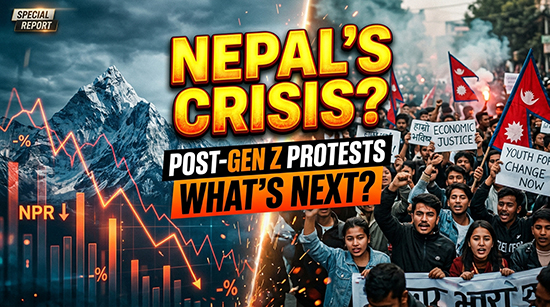
More than a year after the historic youth-led anti-corruption and governance protests of September 2025—which triggered a complete restructuring of the country’s political leadership—Nepal’s economy is navigating a complex recovery phase. The uprising, initially sparked by a controversial social media ban, resulted in profound structural, physical, and fiscal shocks.
As the administration under Prime Minister Balendra Shah steers the country through late 2026, a detailed examination of Nepal’s economic scenario reveals a duality: resilient macroeconomic buffers standing alongside heavy reconstruction burdens, revenue deficits, and cautious private sector sentiment.
The Scale of the Shock: Financial and Physical Damage
Official loss-assessment reports finalized by the Ministry of Finance and national planning committees quantified the total damage to public and private property at approximately Rs. 84.45 billion (roughly $586 million to $630 million), accounting for nearly 1.38% of the country’s GDP and over 4% of the national budget:
- Public Sector Losses (approx. Rs. 44.93 billion): Severe arson and vandalism struck central administrative pillars, including sections of Singha Durbar, the federal Parliament building, the Supreme Court, regional government offices, and police infrastructure.
- Private Sector & Commercial Assets (approx. Rs. 33.54 billion): Major commercial chains, corporate offices (such as Chaudhary Group and Ncell facilities), numerous private establishments, and prominent hotels (including high-end properties like the Hilton Kathmandu) suffered extensive structural fires and inventory looting.
- Production and Service Interruptions: Beyond physical structures, sudden nationwide curfews and the temporary closure of Tribhuvan International Airport inflicted an estimated Rs. 13.87 billion in lost goods, services, and tourism revenue.
Fiscal Strain and Revenue Realities
The aftermath of the unrest placed immense pressure on public finances, forcing aggressive fiscal readjustments:
- Revenue Target Revisions: To incentivize rapid physical rebuilding, the government introduced a 50% customs duty and excise waiver on imported capital goods designated for reconstruction. While vital for recovery, this relief measure temporarily depressed import-based revenue, forcing the Ministry of Finance to officially revise its revenue mobilization target down from Rs. 1,480 billion to Rs. 1,298 billion.
- Insurance Sector Liquidity: Non-life insurance companies faced an unprecedented surge in claims. Gross benefits and claims paid by non-life insurers spiked by over 34% in the immediate aftermath as commercial enterprises sought payouts for damaged inventory, fleet vehicles, and retail facilities.
- Growth Slowdown: International financial institutions, including the World Bank, revised Nepal’s GDP growth projections downward to a moderated band of 2.1% to 2.3%, reflecting the compounding pressures of domestic reconstruction liabilities and broader regional trade headwinds.
Macroeconomic Resilience: The Silver Linings
Despite severe domestic disruptions, certain macroeconomic pillars have demonstrated remarkable resilience, preventing a full-scale balance of payments crisis:
- Robust Foreign Exchange Reserves: Fueled by steady remittance inflows from overseas Nepali workers, foreign exchange reserves climbed to historical highs nearing $20 billion, providing an exceptionally strong import cover of nearly a full year.
- Controlled Inflation: Core inflation rates remained subdued well below the Nepal Rastra Bank’s targeted ceilings, cushioned by stable food supply lines and moderate global commodity prices.
- External Financial Support: Multilateral lenders stepped in with vital liquidity support, including concessional financing frameworks from the International Monetary Fund (IMF) and targeted development grants to stabilize public financial management.
Corporate Sentiment and the Evolving Business Climate
The corporate sector’s recovery has been mixed. While fast-moving consumer goods (FMCG) and multinational subsidiaries report a gradual stabilization in supply chains, overall private sector confidence remains cautious.
- Industrial leaders and chambers of commerce continue to emphasize that restoring long-term investment appetite requires more than just physical rebuilding; it demands predictable regulatory policies, reduced bureaucratic red tape, and institutional guarantees against sudden policy shocks.
- Retailers and hospitality operators note that while domestic consumer demand is recovering from its post-protest dip, high financing costs and tighter credit assessments by commercial banks have slowed down aggressive capital expansion.
Outlook and Strategic Imperatives
Nepal’s economy in late 2026 is defined by a transition from emergency crisis management to structural renewal. For sustainable economic momentum to take hold, economists and policymakers agree that three core milestones must be achieved:
Accelerated Public Reconstruction: Streamlining bureaucratic hurdles to disburse reconstruction funds for destroyed public infrastructure without triggering inflationary fiscal deficits.
Structural Governance Reforms: Implementing transparent public procurement, strengthening central bank autonomy, and reinforcing investor-protection laws to permanently restore business trust.
Diversifying Growth Engines: Leveraging the tech-savvy, digitally native demographic that drove the 2025 movement by expanding digital economy frameworks, green energy exports, and sustainable tourism corridors