
 Published at: 2026-05-22
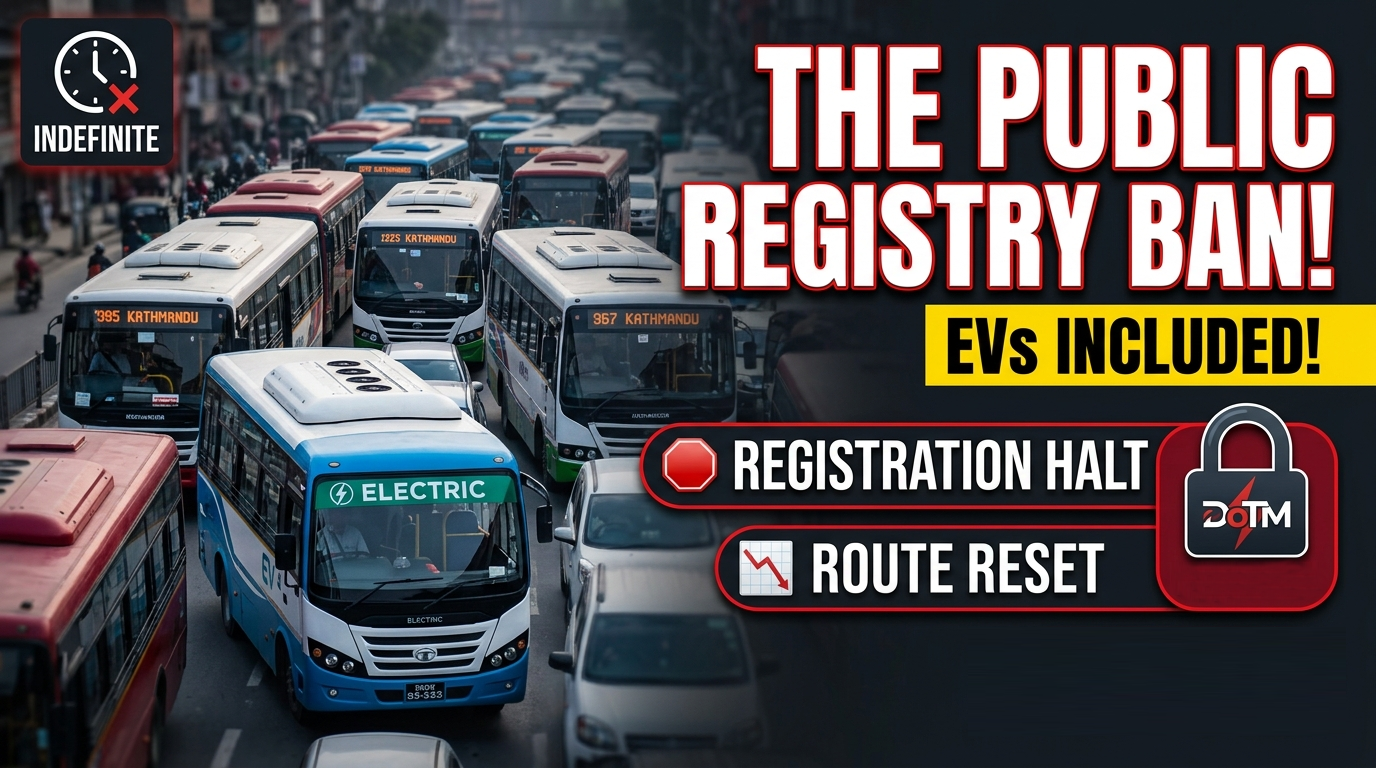
KATHMANDU — In an unprecedented and sweeping policy move, the Government of Nepal has announced an indefinite, nationwide freeze on the registration of all new public transportation vehicles.
The Department of Transport Management (DoTM) issued an official circular to the ministries of Physical Infrastructure, Labour, and Transport Management across all seven provinces, as well as all local government units, ordering an immediate halt to processing new public transit permits.
Remarkably, the freeze is total: it includes not only traditional fossil-fuel-powered buses and microbuses but also electric public transport vehicles (EVs)
Why the Sudden Brake?
According to the official directive signed by DoTM Director Mani Ram Bhusal, the government was forced to step in due to a critical convergence of environmental, logistical, and structural failures across Nepal’s urban networks. The department highlighted four pressing catalysts for the freeze:
Severe Traffic Congestion: The sheer density of public vehicles operating without systemic planning has heavily choked major roadways, creating paralyzing gridlocks and crippling urban mobility.
Infrastructure & Capacity Constraints: The rate of road expansion has failed to keep pace with the chaotic influx of commercial public vehicles, overstretching the limits of existing asphalt.
Fuel Cost Pressures: Rising international fuel costs have added unprecedented operational and economic friction to the public transit ecosystem, complicating standard fare structures and driver sustainability.
Weaponizing the 1993 Transport Act
To enforce this absolute freeze, the DoTM invoked Section 24(3) of the Motor Vehicles and Transport Management Act, 1993 (2049 BS).
The Legal Framework: Section 24(3) legally empowers the central transport department to restrict or completely halt vehicle registrations if it is deemed in the absolute interest of public welfare. The law explicitly allows such interventions when triggered by severe environmental pollution, road capacity limitations, or widespread transit management difficulties.
By deploying this specific legal guardrail, the federal government has effectively bypassed standard local transport syndicate expansions to force a hard reset on how transit routes are allocated.
The EV Controversy: Clean Energy Caught in the Crossfire
The decision to include electric public vehicles (EVs) in the blanket ban has already ignited fierce debate among urban planners and climate advocates.
While the Nepali government has actively promoted EV adoption over recent years to cut down on petroleum dependency and tailpipe emissions, transport officials clarified that clean energy does not solve physical gridlock. An electric bus occupies the exact same physical space as a diesel bus in a traffic jam, meaning the unscientific over-saturation of routes remains a hazard regardless of the vehicle’s fuel source.
What Happens Next? A Shift Toward “Scientific Management”
The DoTM has made it clear that no new public vehicle registrations will be processed until an official, revised directive is formulated.
This freeze acts as a mandatory timeout while the Ministry of Physical Infrastructure and Transport reviews a massive tech-driven overhaul. The government recently finalized draft guidelines aimed at creating a “scientific, tech-equipped public transport system.”
Once the freeze is lifted, any new or existing public vehicle permitted on the roads will likely be legally required to feature:
Mandatory central GPS tracking systems.
Continuous CCTV camera monitoring to prevent passenger harassment.
AI-based facial recognition to automate passenger counts.
Compulsory digital ticketing and QR code scanning to eliminate unregulated cash handling.
Until these stringent technical baselines and rigorous route-mapping systems are institutionalized across the provinces, the gates to Nepal’s public transport registry will remain firmly shut.