
 Published at: 2026-05-22
KATHMANDU — The Spring 2026 mountaineering season on Mount Everest has concluded its most intense phase, leaving behind a trail of rewritten history books and a stark reminder of the logistical pressures facing the world’s highest peak.
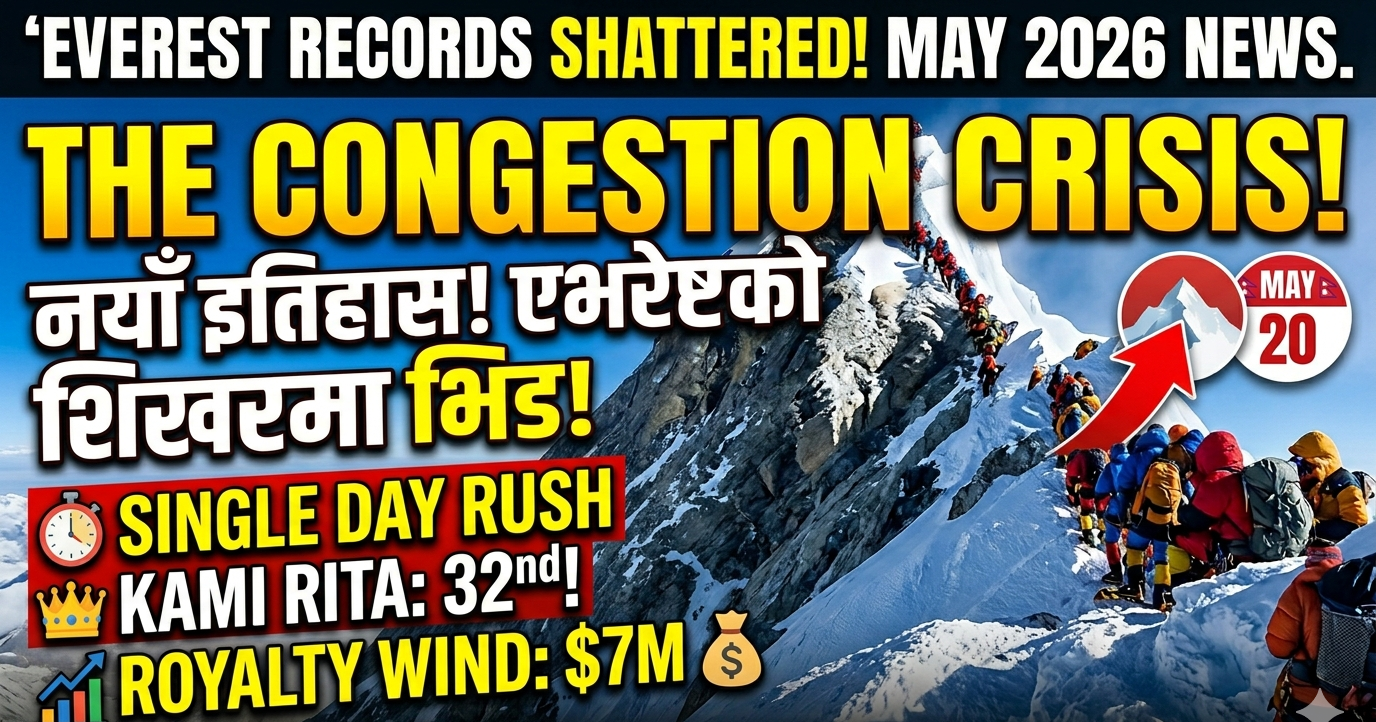
A total of 274 climbers successfully stood on the summit on Wednesday, May 20, 2026. This represents the single busiest, most heavily congested day on the mountain’s southern ridge in history, smashing the previous Nepal-side single-day record of 223 ascents set back in May 2019.
Inside the Perfect Storm: Why Everyone Climbed at Once
The historic bottleneck on May 20 was not an accident of scheduling; it was the direct result of a major environmental delay.
Earlier in May, high-altitude workers known as “icefall doctors” were forced to halt operations to clear a massive, unstable block of glacial ice (a serac) that completely obstructed the Khumbu Icefall route. Consequently, the path from Camp II to the summit was not fully opened and rope-fixed until May 13.
This operational delay created a massive, anxious backlog of hundreds of climbers waiting at Base Camp. When weather forecasts indicated a brief, flawless window of clear skies on Wednesday—followed by heavy winds predicted for later in the week—it triggered an immediate, synchronized rush toward the peak.
THE MAY 20 SUMMIT BREAKDOWN (274 Total)
┌────────────────────────────────────────────────────────┐
│ ■ High-Altitude Sherpa Guides: 150 (54.7%) │
│ □ Foreign Expedition Clients: 124 (45.3%)
This immense convergence meant that 124 foreign clients and 150 local Sherpa guides were forced to squeeze through the narrow, exposed ridges of the “Death Zone” simultaneously.
Everest’s Triple Record: Permits, Revenue, and Crowds
The Department of Tourism has confirmed that the 2026 spring season has effectively transformed Everest into a massive economic engine, setting three structural records:
Permit Peak: Nepal issued an all-time high of 495 individual climbing permits to foreigners across 55 different nations. China led the demographic footprint with 109 climbers, followed closely by the United States (77) and India (61).
The Royalty Windfall: With foreign climbers paying a revised royalty fee of $15,000 each under updated government structures, Everest alone generated Rs 1.07 billion (approx. $7.2 million USD) in state revenue.
The Single-Day Peak: The resulting 274 individual summits on Wednesday officially crown this season as the most concentrated mass ascension on record.
The Masters of the Mountain Extend Their Reign
Amid the mass of commercial expeditions, the world’s most elite high-altitude guides used the mid-May window to stretch their own global boundaries.
Kami Rita Sherpa: The 32nd Ascent
On Sunday, May 17, 2026, at precisely 10:12 AM, 56-year-old Kami Rita Sherpa stood on the peak for an unbelievable 32nd time. Leading an expedition for 14 Peaks Expedition, the Thame native extended his own world record for the most individual ascents of Mount Everest, a journey he began more than three decades ago in 1994.
Lhakpa Sherpa: The Mountain Queen Reaches 11
On that very same historic Sunday morning, veteran female climber Lhakpa Sherpa successfully scaled the peak at 9:30 AM. Her successful ascent marks her 11th time atop Everest, extending her unbreakable world record for the most summits achieved by a woman.
Pure Human Endurance Milestones
- The No-Oxygen Feat: Standing out dramatically within the crowded Wednesday wave, Ecuadorian climber Marcelo Segovia completed a legendary “clean” ascent, reaching the 8,848.86-metre peak entirely without the use of supplemental oxygen or guide support.
- The Youth Milestone: 18-year-old Australian climber Bianca Adler also summited during the mass push on Wednesday, officially becoming the youngest Australian in history to stand on top of the world.
The Reality of the “Death Zone”
While the economic revenue and individual triumphs are being celebrated in Kathmandu, mountaineering experts warn that the 2026 season highlights an escalating hazard.
Compressing nearly 300 people onto a single rope track above 8,000 metres forces climbers to wait in stationary queues for hours. At that altitude, supplemental oxygen bottles deplete rapidly, and the human body undergoes severe, unrecoverable deterioration.
With base camps beginning to clear out as the brief May weather window shuts, the legacy of the Spring 2026 season will likely be defined by a crucial question: How long can human traffic engineering hold out against the volatile climate of the world’s highest peak?