
 Published at: 2024-09-23
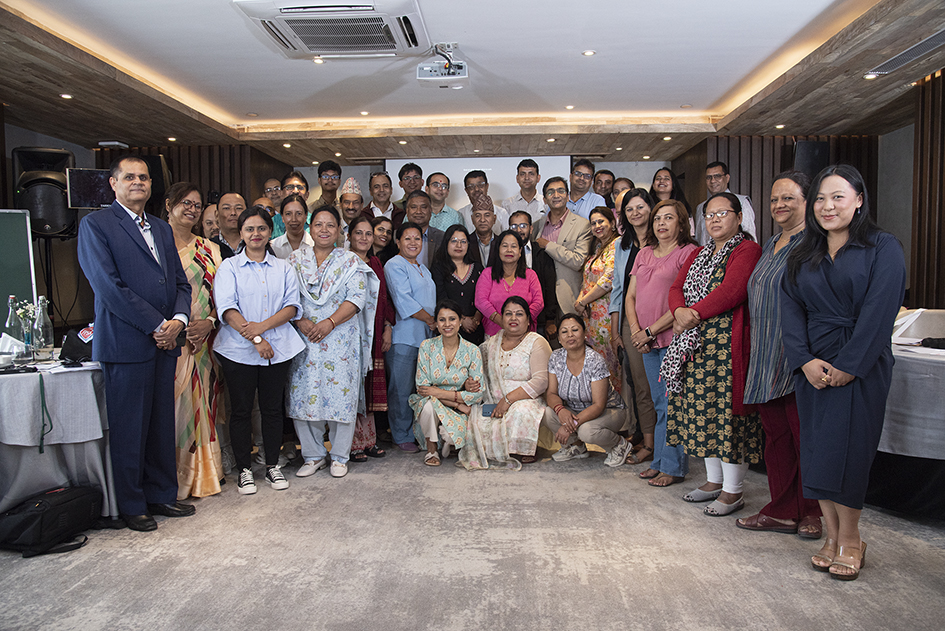
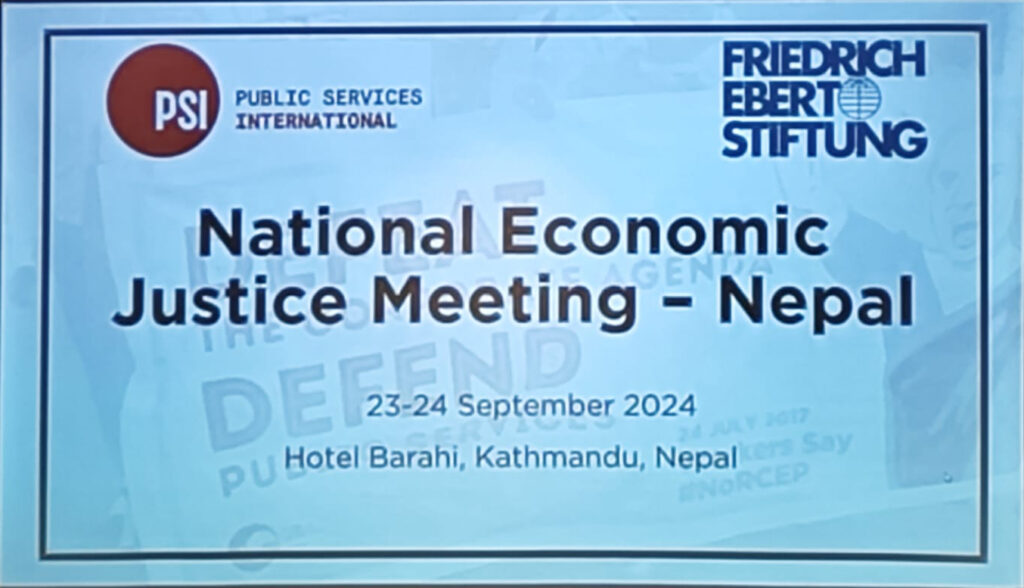
Public Service International (PSI) and Friedrich-Ebert-Stiftung Nepal jointly organized the two-day National Economic Justice Meeting in Kathmandu from today.This meeting organized with the aim of motivating the government to take steps towards a fair global national tax system and to provide essential public services including health services, sanitation and local government services, will be conducted until Tuesday, 24th of September.In Nepal, the tax rates are maintained at 25 percent for general companies and 30 percent for petroleum and banking businesses, which are all acceptable rates. However, despite this, tax evasion and tax exemption is still a major challenge in Nepal In order to end the trend of tax evasion and tax exemption, the government needs to reconsider the existing laws for the purpose of improving tax administration enforcement mechanisms. In this meeting, which will be represented by workers, workers’ representatives, trade union leaders and stakeholders, the meeting will raise its voice for a fair tax system by discussing the current tax system and its impact on workers and public services.
Addressing the opening session of the National Economic Justice Meeting, South Asia Sub-Regional Secretary of Public Service International (PSI), Kannan Raman said that Nepal’s foreign debt has doubled. Raman says that the government expenditure is comparatively low. As a result, the dependents are continuously affected by the public expenditure of the government. As Nepal is in the process of becoming a developed country from a less developed country in 2026, this situation is a major challenge for country. For its permanent solution, we need a fair economic system with fair taxation.
Addressing the opening session of the meeting, the resident representative of Friedrich Ebert Stiftung Nepal, Natalia Figge, said that Nepal’s economy is now in a critical state, first the corona epidemic and then the global economic recession. According to her, at such a time, trade union leaders representing the workers can do important work to protect the interests of the workers. It is now time for trade unions to play a special role for economic justice, social development, equal opportunities and equal policy determination to reduce the existing economic gap and for the rights of workers.She emphasized that In Nepal, 10 percent of the rich have 40 percent of the property, while 20 percent of the poor people have only 4 percent of the national property, which is against the principle of redistribution of justice, trade union leaders must be serious about it.
In the meeting, while discussing various dimensions of “Critically assessing Nepal’s current tax policies and what can be done to improve revenue for public services”, economist professor Achyut Wagle said that the revenue deficit has been increasing alarmingly in recent days in Nepal. Revenue collection has decreased by 31.4 percent in the last financial year. This is a dangerous situation in a country like Nepal as revenue collection is the only major source of government income. According to a recent study, every year more than 2 billion dollars go in revenue exemption, the reality of Nepal is bad, which is really sad, Wagle says.
Professor Wagle says that the common people of Nepal have been suffering under the heavy burden of indirect taxes, it should be stopped and the amount of direct taxes should be increased. Trade unions should be careful about the collusion of politicians, administrations and businessmen as revenue is being embezzled. During the session, the meeting will intensively brainstorm about the different dimensions of the measures to create an environment that will contribute fairly to the welfare of the workers, including the rich and the corporate.